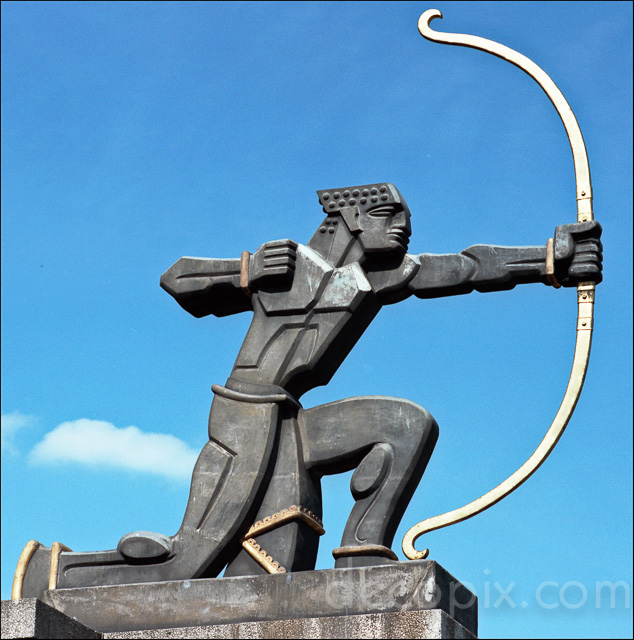
In the early part of the twentieth century, a new architectural style, now called Art Deco, offered a different, more modern direction in design.
This break with tradition was gradual, with some Art Deco buildings notable mostly for their ornament; more repackaging than innovation. That said, by the mid-1920s a combination of prosperity, optimism, exotic materials and fine craftsmanship produced some spectacular and exciting architecture.
For big business, Art Deco was ideal for expressing corporate wealth and dominance. Banks used the style to convey security. Hollywood used it to define the good life. But soon, the good life proffered by Hollywood would be just that; the stuff of dreams. When the stock market crash brought down the curtain in 1929, it took the first phase of the Art Deco era with it. In Manhattan, the Empire State Building was completed in 1931 and for some time after there was little construction of any kind, with the sole exception of Rockefeller Center.
For better or worse, in those days it took time for Wall Street’s problems to fully affect other parts of the world. So, in far away places like Australia, Art Deco buildings were built into the 1940s. But in the birthplace of the skyscraper, the party was over.
One consequence of the Depression was the emergence of a more austere architectural style, referred to on this site as Streamline Moderne. Why not just say Art Deco? Because nearly everything about the Streamline Moderne was different and sometimes even a reaction to Art Deco.
If Art Deco skyscrapers could be thought of as “vertical”, Streamline Moderne buildings typically embraced horizontal massing. The ornament in a streamlined building, if any, was typically modest and cost-effective, whereas with Art Deco, the sky was the limit. While Art Deco buildings dazzled with intricate details and sharp angles, streamlining featured clean surfaces and curves. In a few places, the two styles were combined but in the simplest terms, Art Deco was born before the financial collapse and Streamline Moderne, after.
None of this is to say that the Streamline Moderne couldn’t produce delightful results, and with its graceful curves, streamlining translated beautifully into thousands of objects that are still treasured.
I should point out that the Art Deco houses on this site are, with few exceptions really Streamline Moderne. Although true Art Deco houses exist, they are so few in number that any collection of Art Deco homes really has to include streamlined examples.
There is no way to measure, but it seems that Art Deco and Streamline Moderne buildings are more popular today then they were in their own time. Of the two, the Streamline Moderne had a much longer run. It survived the war and went on to be used for a new generation of schools, factories, grocery stores and gas stations.
In an earlier version of this essay I remarked that I often wonder how things might look today, had there been no Depression or a second World War. But this sort of guessing is a fool’s errand especially when so much from the period remains, to be seen, preserved and enjoyed.
Randy Juster
July 2010